
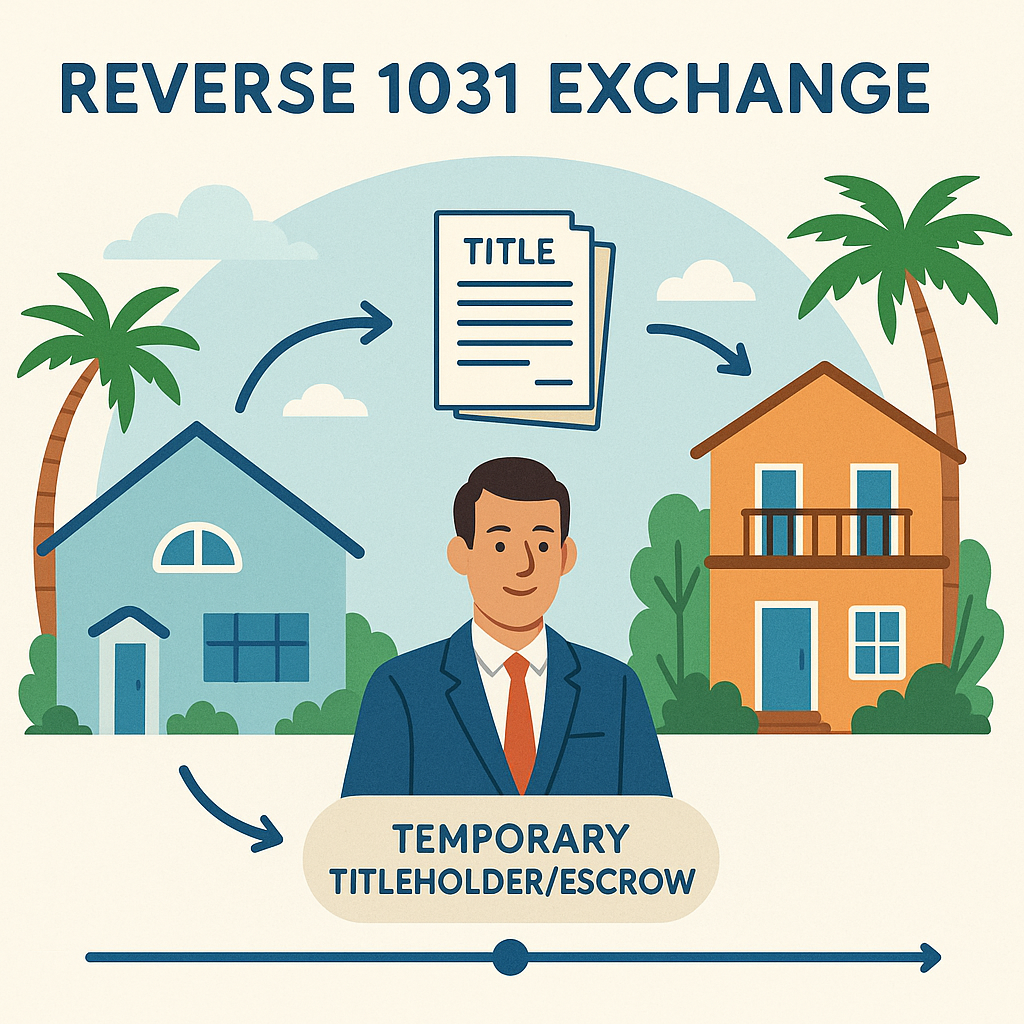
Cue dramatic pause — because yes, real estate can somehow make “buy first, sell later” sound like a tax strategy instead of a chaotic weekend decision.
A reverse 1031 exchange lets an investor buy the replacement property first and sell the relinquished property later while still aiming to defer capital gains taxes under Section 1031. In plain English: it’s a way to lock in the deal you want now, then clean up the sale later — with the IRS watching like a very serious hall monitor.
It’s powerful. It’s useful. And it comes with enough moving parts to make even a seasoned investor whisper, “Why is there another LLC involved?”

What Is a Reverse 1031 Exchange?
A reverse 1031 exchange is a tax-deferral strategy that lets an investor acquire the replacement property before selling the relinquished property.
In a traditional 1031 exchange, you sell first and buy later. In a reverse exchange, the order is flipped. Same basic goal, different choreography. Think of it like rearranging the furniture in your house: same stuff, just more tripping hazards.
According to IRS guidance and industry sources like IPX 1031, Northmarq, and Thomson Reuters, the big issue is ownership timing. You cannot directly own both properties at the same time during the exchange. That’s where the Exchange Accommodation Titleholder (EAT) enters the scene like a very expensive stage manager.
Quick version:
– You buy the new property first
– A third party temporarily “parks” title
– You sell the old property within the required window
– The exchange is unwound once everything is complete
This is especially useful when the replacement property is hot, scarce, or likely to disappear faster than free office donuts. Takeaway: A reverse 1031 exchange helps investors buy first and sell later, but the title structure has to be handled carefully.
Why Investors Use a Reverse Exchange
Hot take incoming: in a competitive market, timing is everything.
A reverse exchange is often used when an investor finds the right property before their current property sells. If you wait around for your sale to close first, you may lose the opportunity. And in real estate, “we almost bought it” is just another way of saying “we lost to a better-prepared buyer.”
Industry sources like Northmarq and First Exchange note that investors often use reverse exchanges when they:
– Want to avoid losing a desirable asset
– Need more time to sell their current property
– Are repositioning a portfolio
– Are upgrading into a larger or better-performing property
The tradeoff? More structure, more paperwork, more fees, more people on the email chain pretending they know what “parked title” means. Takeaway: A reverse exchange buys you flexibility, but that flexibility comes with extra cost and complexity.

How a Reverse 1031 Exchange Works Step by Step
Here’s the process in plain English, not IRS-robot language.
1. Engage the Right Professionals
Before anything closes, you need the right team in place:
– A qualified intermediary or exchange accommodator
– A real estate attorney
– A CPA or tax advisor
– A lender familiar with reverse exchanges
This is not the place for “my cousin does taxes” energy. Reverse exchanges depend on legal documents, title arrangements, and strict timing. One wrong move and the whole thing can go from strategic to tragic in a hurry. Takeaway: Line up professionals early, because reverse exchanges reward preparation and punish chaos.
2. Set Up the Parking Arrangement
The IRS allows reverse exchanges under a safe harbor structure in Revenue Procedure 2000-37.
Under that setup, the EAT temporarily holds title to either the replacement property or the relinquished property. Most commonly, the EAT holds the replacement property while the investor works on selling the old one.
Usually, the EAT is formed as a separate LLC. It must be independent and not a disqualified person. Translation: your exchange entity should not be your alter ego with a nicer business card. Takeaway: The EAT is the legal placeholder that keeps you from owning both properties at once.
3. Buy the Replacement Property
The EAT acquires the replacement property first.
The investor does not take direct title yet, even though they are economically involved in the deal. This is the heart of the reverse exchange structure. You’re basically the person driving the car while someone else holds the title in the glove box. Takeaway: The replacement property gets secured first, but legal title temporarily stays with the EAT.
4. Sell the Relinquished Property
Next, the old property is sold within the exchange period.
Once that sale closes, the proceeds are used to reimburse the EAT or reduce the financing tied to the parked property. This part matters because the sale is what completes the exchange structure and gets everyone to the finish line. Takeaway: The relinquished property has to sell within the required timeframe or the tax-deferred treatment can fall apart.
5. Transfer Title to the Investor
After the sale is complete and all exchange rules are satisfied, the EAT transfers title of the parked property to the investor.
That’s the finish line. The reverse exchange is done, and the investor ends up owning the replacement property directly. Takeaway: The exchange isn’t finished until the parked property is transferred properly to the investor.
The IRS Rules You Need to Know
Now, before your brain files for bankruptcy, let’s look at the actual rules.
Reverse 1031 exchanges still have to satisfy the broader requirements of Section 1031. Here are the big ones.
Like-Kind Property
Both properties must be held for investment or business use. They must also be like-kind real estate, which is broadly defined for real property.
That means you can usually exchange:
– Apartment building for office building
– Retail center for industrial property
– Land for another investment property
You generally cannot use a 1031 exchange for a personal residence. The IRS is many things, but “house swap friendly” is not one of them. Takeaway: The properties must be investment or business real estate, not your primary home.
The 180-Day Window
The entire reverse exchange has to fit within 180 days.
Industry guidance from IPX 1031 and Atlas 1031 emphasizes that this deadline is critical. If the relinquished property isn’t sold within 180 days, the transaction can fail to qualify for tax deferral. Takeaway: The 180-day clock starts ticking fast, and the IRS does not extend deadlines because “the market got weird.”
No Direct Ownership of Both Properties
This is a big one.
The taxpayer cannot hold title to both the relinquished and replacement properties at the same time. That’s why the EAT structure exists in the first place. Takeaway: If you directly own both properties at once, you’ve likely broken the exchange structure.
Qualified Exchange Accommodation Arrangement
The parking arrangement must be documented through a Qualified Exchange Accommodation Arrangement (QEAA).
This is the agreement that formalizes the reverse exchange structure and helps fit the transaction within the IRS safe harbor. Takeaway: If the QEAA is missing or sloppy, the whole strategy can wobble like a folding chair on uneven concrete.
Reverse Exchange Timeline vs. Forward Exchange Timeline
A traditional forward 1031 exchange usually looks like this:
1. Sell the old property
2. Identify a replacement property within 45 days
3. Close on the replacement property within 180 days
A reverse exchange flips the sequence:
1. Buy the replacement property first
2. Park title with the EAT
3. Sell the old property within 180 days
4. Transfer title to the investor
One major difference: there is no 45-day identification period in the same way there is in a standard forward exchange, because the replacement property has already been acquired. Takeaway: Reverse exchanges flip the order, but they still live and die by the 180-day deadline.
What Is an Exchange Accommodation Titleholder?
The Exchange Accommodation Titleholder, or EAT, is the temporary titleholder that makes the reverse exchange possible.
Think of the EAT as the person holding your seat at the table while you run to the buffet. You’re still in the game, but somebody else is temporarily in possession of the paperwork.
According to sources like IPX 1031 and First Exchange, the EAT must:
– Hold title temporarily
– Be independent from the taxpayer
– Follow the QEAA structure
– Transfer the property once the exchange is complete
This is a highly technical part of the process, which is why experienced professionals matter so much here. Takeaway: The EAT is not optional flair — it’s the structure that makes the reverse exchange work.
Safe Harbor vs. Non-Safe Harbor Reverse Exchanges
The most common and safest structure is the IRS safe harbor arrangement under Revenue Procedure 2000-37.
Why does safe harbor matter? Because it gives taxpayers a clearer roadmap. And in tax law, “clear roadmap” is basically the adult version of comfort food.
A non-safe-harbor reverse exchange may still be possible, but it carries more risk. Most investors prefer the safe harbor because it offers more certainty if the rules are followed correctly. Takeaway: Safe harbor is usually the smarter, lower-drama choice.

Benefits of a Reverse 1031 Exchange
Reverse exchanges are not just a fancy tax trick. They solve real-world problems.
1. You Can Secure the Right Property First
This is the headline benefit. If the perfect replacement property shows up, you don’t have to lose it just because your current property hasn’t sold yet.
Takeaway: Reverse exchanges help you act fast when the right deal appears.
2. It Reduces Market Risk
In a fast-moving or rising market, waiting to sell first can be risky. A reverse exchange lets you move quickly and reduce the chance of missing out.
Takeaway: If timing is tight, a reverse exchange can keep you from getting boxed out.
3. It Can Support Portfolio Upgrades
Investors often use reverse exchanges to move from:
– Lower-value to higher-value properties
– Older assets to newer ones
– Less stable properties to stronger investments
Takeaway: This strategy is useful when you’re upgrading the quality of your portfolio, not just swapping keys for sport.
4. It Preserves Tax Deferral
If structured correctly, the exchange can defer capital gains taxes and preserve more capital for reinvestment.
Takeaway: More deferred tax means more cash staying in the deal instead of heading to the IRS first.
Drawbacks and Risks
Now for the part where the plot thickens.
Reverse exchanges are useful, but they are not simple.
1. Higher Costs
Because of the extra legal structure and title parking, reverse exchanges usually cost more than standard exchanges.
Possible costs include:
– EAT setup and admin fees
– Qualified intermediary fees
– Legal and accounting fees
– Bridge loan or financing costs
Takeaway: A reverse exchange can save taxes, but it definitely does not save on paperwork or professional fees.
2. Financing Can Be More Complicated
The EAT often needs temporary financing, and some lenders are not exactly thrilled by reverse structures. That can make funding more complicated.
Takeaway: Make sure your lender speaks reverse 1031 before you’re standing at the closing table blinking in confusion.
3. The Timeline Is Tight
If the relinquished property doesn’t sell within 180 days, the exchange may fail.
Takeaway: In reverse exchanges, time is not your friend — it’s your overbearing project manager.
4. It Requires Careful Coordination
One mistake in title, timing, or documentation can jeopardize the whole transaction.
Takeaway: This is a precision strategy, not a “close enough” strategy.
Common Mistakes to Avoid
Reverse exchanges are not the place to freestyle.
Some of the most common mistakes include:
– Waiting too long to involve a qualified intermediary
– Taking title to both properties directly
– Missing the 180-day deadline
– Skipping the QEAA
– Using an inexperienced lender
– Assuming every property qualifies
– Ignoring debt replacement or boot
– Forgetting about state tax consequences
A reverse exchange is one of those situations where “we’ll figure it out later” is basically tax-law code for “please enjoy your unexpected bill.” Takeaway: Small mistakes can trigger big tax consequences, so don’t wing it.
Is a Reverse 1031 Exchange Right for You?
A reverse exchange may be a good fit if:
– You found the right property and can’t risk losing it
– You have a likely buyer for your current property
– You have access to financing or liquidity
– You’re working with professionals who understand reverse structures
It may not be the right fit if:
– You need a simple transaction
– You don’t have the capital to support the parking structure
– Your current property will be hard to sell quickly
– You’re not comfortable with extra complexity
Takeaway: If your deal needs speed and precision, a reverse exchange can be smart — but only if your finances and team are ready.
Final Thoughts
A reverse 1031 exchange is one of the most flexible tax-deferral strategies available to real estate investors, but it’s also one of the most complex. In plain English: it lets you buy first and sell later while still aiming to preserve the tax benefits of a 1031 exchange.
The key points to remember are:
– The replacement property is acquired before the relinquished property is sold
– An EAT and QEAA are typically used to keep the structure compliant
– The exchange usually must be completed within 180 days
– Costs, financing, and documentation are more complicated than in a standard exchange
– Professional guidance is essential
If you’re considering a reverse exchange, start planning early. The more time you give yourself to coordinate financing, title, and tax strategy, the smoother the deal is likely to be.
Takeaway: The best reverse exchanges don’t happen by accident — they happen because someone planned ahead like a legend.
Contact me with any questions at [email protected] or reply to this post to subscribe to my monthly commercial real estate newsletter for more insights.