
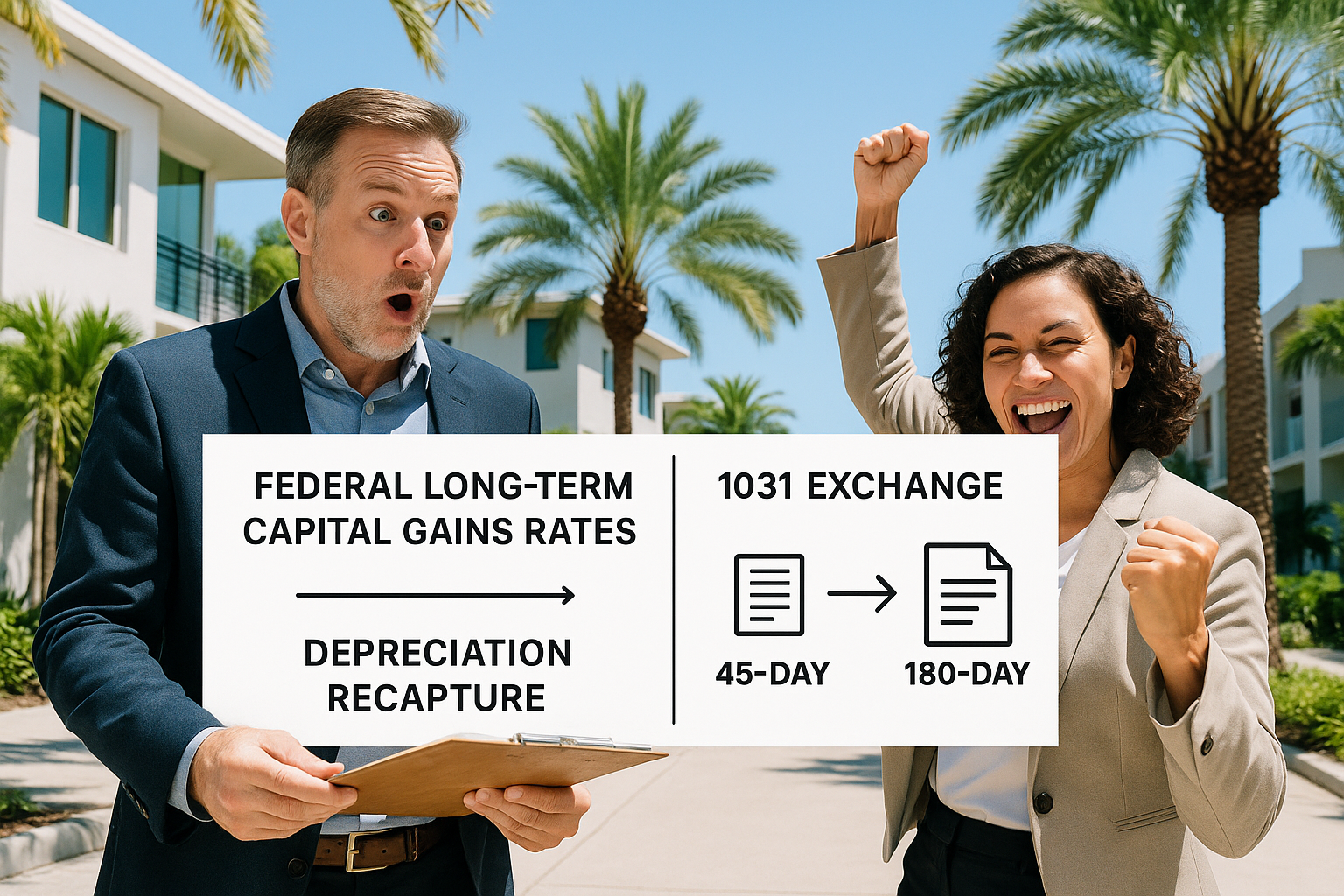
Selling commercial real estate can feel a lot like discovering the “small print” brought a suitcase. The headline number looks great, but the real story lives in the taxes, depreciation recapture, and whether a 1031 exchange can save you from an IRS-induced headache.
Capital gains on commercial property are the taxes you may owe on the profit from a sale after accounting for your adjusted basis. In plain English: it’s not what you sold it for, it’s what you keep after the tax dust settles.
If you’ve ever asked, “How do capital gains work on commercial property?” or “Will a 1031 exchange help me defer taxes?” you’re asking the right questions. Especially in markets like Tampa and across Florida, where investors are always trying to keep more of the deal and less of the drama.

What Are Capital Gains on Commercial Property?
Capital gains tax is the tax on the profit you make when you sell a property for more than your adjusted basis.
Your adjusted basis usually includes:
– What you paid for the property
– Certain acquisition costs
– Capital improvements you’ve made
– Minus depreciation you’ve claimed over time
That depreciation piece? Oh yes, it’s the tax equivalent of a boomerang.
A Simple Example
Let’s say you bought a commercial building for $2 million and put another $300,000 into improvements. Over time, you claimed $400,000 in depreciation.
Your adjusted basis would look like this:
– Purchase price: $2,000,000
– Improvements: $300,000
– Less depreciation: $400,000
Adjusted basis = $1,900,000
If you later sell for $2.6 million, your total gain is:
$2,600,000 – $1,900,000 = $700,000
That gain does not always get taxed as one neat little pile. Because tax law apparently enjoys making simple things feel like a group project.
Pro tip: Keep records of improvements and depreciation from day one. Future-you will be extremely grateful when the math starts acting like it had three espressos.

Federal Capital Gains Tax Rates on Commercial Property
The federal tax treatment depends largely on how long you owned the property.
Short-Term vs. Long-Term Gains
If you held the property for one year or less, the gain is generally treated as short-term capital gain and taxed like ordinary income.
If you held the property for more than one year, it is generally treated as long-term capital gain, which gets preferential federal rates.
According to IRS rules, long-term capital gains are generally taxed at 0%, 15%, or 20%, depending on your taxable income.
Why This Matters
That difference can be huge. Ordinary income rates can be much higher than long-term capital gains rates, so simply holding a property long enough can save a very real chunk of money.
Pro tip: If you are close to the one-year mark, do not rush the sale unless you have run the numbers. A few extra weeks can sometimes save a very unfun amount of tax.
Depreciation Recapture: The Part Many Owners Forget
This is where a lot of owners get a surprise bill and suddenly develop a deep, spiritual interest in tax law.
Commercial property is depreciated over time for tax purposes. That depreciation helps reduce taxable income while you own the property. But when you sell, the IRS wants some of that benefit back.
What Is Unrecaptured Section 1250 Gain?
For most commercial buildings, depreciation taken on the structure can be taxed at a maximum rate of 25% when the property is sold. This is commonly called unrecaptured Section 1250 gain.
So, your sale gain may be split into two parts:
1. Depreciation recapture, taxed up to 25%
2. Remaining capital gain, taxed at 0%, 15%, or 20% depending on your income
Why Investors Need to Pay Attention
If you have owned a property for years and claimed a lot of depreciation, your tax bill may be bigger than you expected, even if the sale looks fantastic on paper.
Example
Suppose you sell and realize a $1 million gain, with $300,000 tied to depreciation.
– $300,000 may be taxed at up to 25%
– The remaining $700,000 may be taxed at long-term capital gains rates
That is why planning before you sell matters. A great sale price does not automatically equal great after-tax proceeds.
Pro tip: Depreciation is excellent while you own the building. At sale time, it can turn into the tax version of a plot twist.

How Much Capital Gains Tax Will You Pay?
Short answer: it depends. Long answer: it depends on several moving parts that love to show up all at once.
Your total tax bill may depend on:
– Your income level
– Your filing status
– How long you owned the property
– How much depreciation you claimed
– Whether your state taxes capital gains
– Whether you qualify for a 1031 exchange
– Whether Net Investment Income Tax applies
Federal Long-Term Capital Gains Rates
For most taxpayers, the federal long-term capital gains rates are:
– 0%
– 15%
– 20%
Some higher-income taxpayers may also owe the 3.8% Net Investment Income Tax (NIIT) on certain investment income, including gains from commercial property sales.
So yes, the “headline” rate may be 20%, but the real-world number can be higher once NIIT joins the party uninvited.
Pro tip: Do not estimate taxes using only the sale price and a calculator app. Use a real tax projection, not a vibes-based spreadsheet.
State Taxes Can Change the Picture
Federal taxes are only part of the story. State taxes can take a big bite too, and in some states, capital gains are taxed just like regular income.
State Tax Considerations
State tax rules vary widely:
– Some states have no state income tax
– Others tax gains at ordinary income rates
– Some have especially high top marginal rates
For example, Florida has no state income tax, which is part of why it stays so attractive to commercial investors. Meanwhile, other states can stack an extra layer of tax on top of the federal bill.
That means the total tax on a commercial property sale can rise fast once state rules are added. If you own across state lines, the plot thickens.
Pro tip: Always check state tax rules before you celebrate the sale. Nothing kills a victory lap like an unexpected tax bill.

Can You Avoid Capital Gains Tax on Commercial Property?
Usually, you cannot make the tax disappear entirely. But you may be able to defer it, which is often the next best thing.
The 1031 Exchange
One of the most common strategies is the 1031 like-kind exchange.
A 1031 exchange lets you defer capital gains taxes by selling one investment property and reinvesting the proceeds into another qualifying property.
According to IRS rules, the replacement property must generally be:
– Like kind
– Identified and acquired within strict time limits
– Purchased through a qualified intermediary
Key Deadlines
The deadlines are not suggestions. They are the whole game.
– Identify replacement property within 45 days
– Complete the purchase within 180 days
Miss those deadlines and the tax deferral can disappear faster than a parking spot during a tenant move-in.
What 1031 Does and Does Not Do
A 1031 exchange usually defers tax rather than eliminating it permanently. The gain carries into the next property.
That can still be incredibly useful if you want to:
– Preserve more cash for reinvestment
– Upgrade into a larger asset
– Reposition your portfolio without an immediate tax hit
Pro tip: If a 1031 exchange is even a maybe, bring it up early. Waiting until after the deal is already moving is how investors end up staring at the clock like it owes them money.
Practical Tax Planning Tips Before Selling
A little planning can save a lot of pain. And in commercial real estate, “pain” often arrives as a surprise tax bill with terrific timing and terrible manners.
1. Review Your Depreciation Schedule
Check how much depreciation you have claimed. That is the foundation for estimating recapture.
2. Estimate Your Adjusted Basis
Your CPA can help calculate your adjusted basis, which determines your gain.
3. Model Different Sale Scenarios
Run the numbers for different sale prices, closing dates, and reinvestment options.
4. Consider a 1031 Exchange Early
A 1031 exchange is time-sensitive. If you wait until after accepting an offer, you may be boxed in.
5. Check State Tax Rules
State taxes can materially change your net proceeds, especially in higher-tax states.
6. Coordinate With Your CPA and Attorney
Commercial sales often involve tax, legal, and transaction strategy all at once. The earlier your team is involved, the better.
Pro tip: Think of your exit plan like a lease negotiation — the earlier you read the fine print, the fewer “surprises” jump out later.
Real-World Perspective: Why the After-Tax Number Matters Most
A common mistake owners make is focusing only on the sale price.
But the number that matters most is the after-tax proceeds.
Two sales can both show a $1 million gain, but the actual cash you keep can be wildly different depending on:
– Depreciation claimed
– Federal bracket
– State taxes
– NIIT
– Whether a 1031 exchange is used
That is why smart investors think about taxes before they list, not after the wire hits. In commercial real estate, tax planning is part of the investment strategy, not a bonus round.
Pro tip: Do not ask, “What can I sell it for?” Ask, “What do I actually get to keep?” That is the real money question.
Recent Guidance and Ongoing Rules
As of current IRS guidance, the main federal framework remains:
– Long-term capital gains are generally taxed at 0%, 15%, or 20%
– Depreciation on commercial buildings can trigger unrecaptured Section 1250 gain taxed up to 25%
– A 1031 exchange can defer tax if structured correctly
– State taxes may significantly increase the total bill
The IRS also adjusts capital gains thresholds for inflation each year, so current brackets should always be verified before making a sale decision.
Pro tip: Tax rules change just often enough to be annoying, so verify current thresholds before making a move. A little checking now beats a lot of regretting later.
Key Takeaways
Selling commercial property can create a meaningful tax event, but once you understand the basics, it is much less mysterious:
– Long-term capital gains usually get better tax treatment than ordinary income
– Depreciation lowers your basis and can increase taxable gain at sale
– Part of the gain may be taxed at up to 25% because of depreciation recapture
– A 1031 exchange can help defer taxes if done correctly
– State taxes can materially increase your total liability
– Planning before the sale can improve your after-tax outcome
If you are thinking about selling commercial real estate, do not wait until closing to think about taxes. The earlier you plan, the more options you usually have.
Contact me with any questions at [email protected] or reply to this post to subscribe to my monthly commercial real estate newsletter for more insights.