
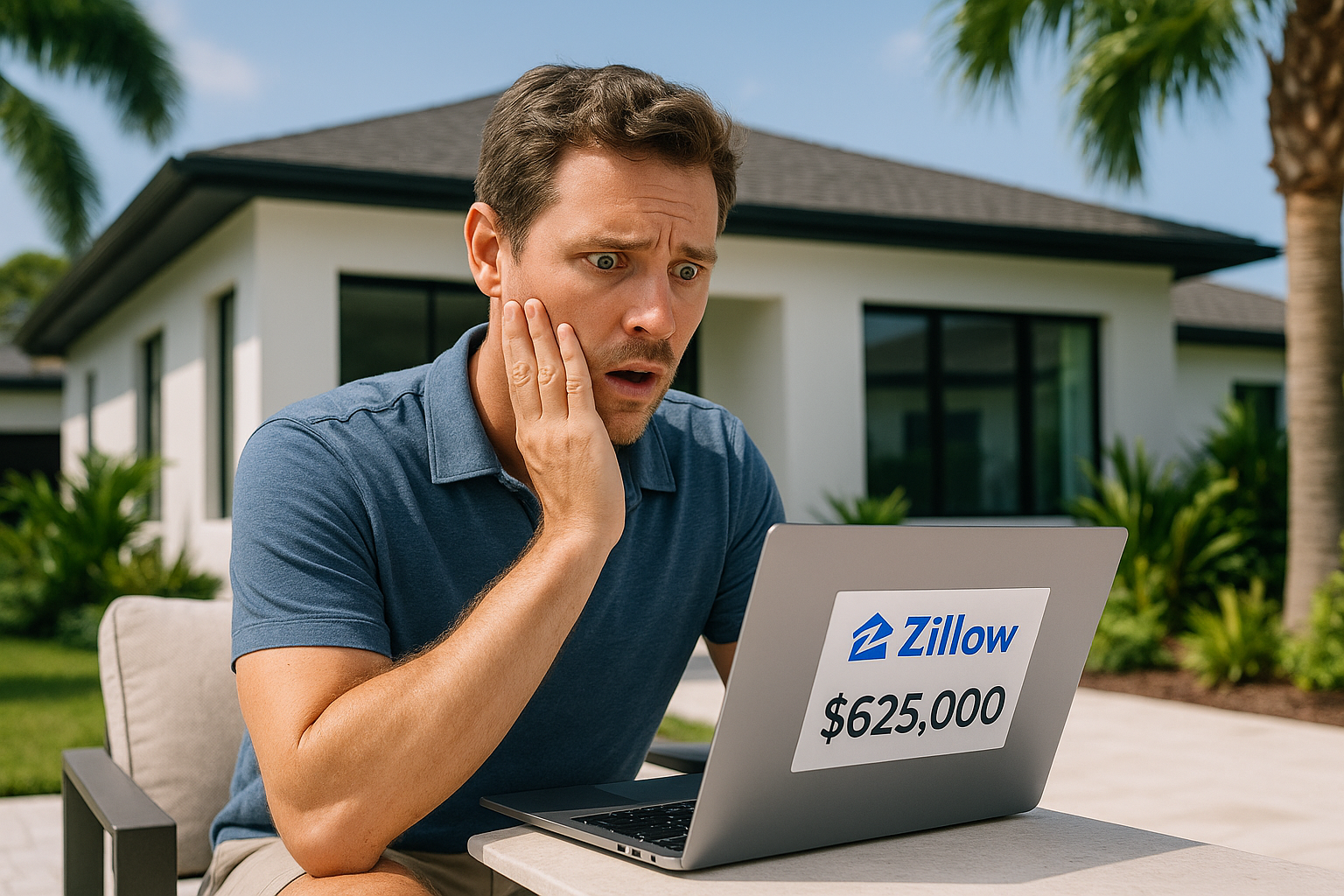
Let’s be real: almost every homeowner has typed their address into Zillow like they’re checking a school report card they didn’t ask for. One minute you’re feeling great about your place, and the next—cue dramatic pause—Zillow is politely telling you your castle is worth less than you hoped. Rude, but in a very algorithmic way.
So, how accurate are Zillow Zestimates?
The short answer: pretty decent for homes actively listed for sale, but a lot shakier for off-market homes. In other words, Zillow can be a useful first glance, but it is not the final word on value. If you’re making big money decisions off that number alone, that’s like using a gas station scale to weigh a couch.

Zillow Zestimate Accuracy: What the Numbers Actually Say
Now, before your eyes glaze over like a fresh donut, let’s look at the actual numbers.
According to Zillow’s own data, the nationwide median error rate for on-market homes is 1.74%, while the median error rate for off-market homes is 7.20%. That’s a big difference.
Here’s what that means in plain English:
– If a home is listed for sale, the Zestimate is usually fairly close.
– If a home is not on the market, the estimate can miss by a much wider margin.
Industry summaries and recent 2024 and 2025 analyses show similar trends, with on-market estimates generally in the 1.8% to 2.4% range and off-market estimates around 7% or higher.
On a $400,000 home:
– A 2% error is about $8,000
– A 7% error is about $28,000
That’s not pocket change. That’s “new HVAC or emotional eating” money.
Pro tip: A Zestimate is a quick snapshot, not a certified valuation. Use it like a weather forecast, not a legal contract.
On-Market vs. Off-Market Zillow Zestimates: Why the Gap Is So Big
The biggest reason Zillow Zestimates are more accurate for some homes than others is simple: Zillow has better, fresher data when a home is actively listed.
On-Market Homes
When a home is for sale, Zillow can work with more current information, including:
– list price
– updated square footage
– photos
– bedroom and bathroom counts
– recent comparable sales
– nearby market activity
That gives the algorithm a lot more to chew on. Zillow reports that roughly 70% of on-market Zestimates fall within 5% of the final sale price, and about 90% fall within 10%.
That’s not perfect, but it’s decent enough for a first pass.
Takeaway: If the home is on the market, the Zestimate is usually more useful because it has more current facts feeding the beast.
Off-Market Homes
For homes not currently listed, Zillow leans much more heavily on public records and historical data. That means the estimate may completely miss things like:
– renovations
– deferred maintenance
– interior upgrades
– damage
– neighborhood shifts in demand
And let’s be honest, public records are not exactly known for knowing that the kitchen was updated in 2022 and no, the granite does not “count” if it’s from the Clinton administration.
Recent reporting suggests only about 43% of off-market estimates are within 5% of market value.
That’s a much wider wobble.
Pro tip: If your home is off-market, treat the Zestimate like a rough guess from a very confident robot.

What Makes a Zillow Zestimate More or Less Accurate?
Zillow’s model is smart, but it has blind spots. Big ones. Like “can’t smell the mildew” blind spots.
1. Data Quality
If the public records are wrong, the Zestimate can be wrong too.
Things like:
– incorrect square footage
– missing bathrooms
– outdated lot size
– wrong property type
…can all skew the estimate.
Takeaway: Bad data in, bad value out. Garbage in, garbage out, but with better branding.
2. Location
Zestimates tend to perform better in areas with plenty of sales and strong public records.
In rural areas or places with fewer comparable homes, the model has less to work with. And when there are fewer comps, the algorithm starts squinting into the void like the rest of us trying to guess mortgage rates.
Takeaway: The more active and data-rich the market, the better the estimate usually gets.
3. Property Type
A standard suburban home is easier to value than a one-of-a-kind property.
Harder-to-price properties include:
– luxury homes
– custom builds
– mixed-use buildings
– unusual floor plans
– commercial properties with odd lease structures
Algorithms love normal. They get nervous around “unique.”
Takeaway: The weirder the property, the less you should trust a quick automated value.
4. Home Condition
This is one of Zillow’s biggest blind spots.
Zillow cannot walk through your house and notice:
– the remodeled kitchen
– the roof that’s seen better decades
– the surprise plumbing issue hiding behind the wall
– the “vintage” carpet smell nobody asked for
Unless that information is entered or shows up in records, the Zestimate won’t know.
Takeaway: A beautiful interior or a rough-condition home can make the Zestimate swing way off target.
5. Market Volatility
When the market changes quickly, automated estimates can lag.
If mortgage rates jump, buyer demand softens, or inventory suddenly tightens, the algorithm may not react as fast as local market conditions. The market can change quicker than your neighbor can mention it at a backyard barbecue.
Takeaway: In a fast-moving market, even a decent automated estimate can get stale fast.

A Smart Way to Think About Zillow Zestimates
Hot take incoming: the Zestimate is best viewed as a starting point, not a finish line.
If your home is on the market, it can give you a reasonable snapshot of likely value. If your home is off the market, it’s more like a ballpark estimate with a wink and a shrug.
That matters because different situations call for different levels of accuracy:
– A listed home in a strong comp market may have a Zestimate close enough to help with early pricing discussions.
– A unique off-market home with upgrades, repairs, or odd features may be wildly under- or overestimated.
That’s why real estate agents, appraisers, and local market data still matter. They bring context, condition, and neighborhood nuance that no algorithm can fully capture.
Pro tip: Use the Zestimate to start the conversation, not to end it.
Recent Zillow Improvements: Better, But Not Magic
Zillow has made real efforts to improve its model over time. The company has also become more transparent about accuracy.
Some notable improvements include:
– clearer separation between on-market and off-market estimates
– visible error ranges on some listings
– encouragement for homeowners to update property facts
– steady improvement in reported on-market accuracy
That’s good news. But let’s not throw a parade just yet. A better algorithm is still not the same thing as a formal appraisal or a detailed comparative market analysis.
Takeaway: Zillow has improved, but “improved” is not the same as “perfect.”

How to Use a Zillow Zestimate Wisely
If you’re a buyer, seller, or homeowner, here’s the common-sense play:
1. Use it as a first look, not the final number.
2. Compare it with recent neighborhood sales.
3. Check the Zestimate range, not just the headline value.
4. Review the property facts Zillow is using.
5. Talk to a local real estate professional before making pricing decisions.
If you own the home, claim your property on Zillow and update the facts if anything is off. A better data profile can help improve the estimate.
Think of it this way: if the robot is going to make a guess, at least hand it the right cheat sheet.
Pro tip: A few minutes of updating property facts can save you from a wildly inaccurate estimate and a mildly dramatic emotional spiral.
So, how accurate are Zillow Zestimates?
Here’s the clean version:
– On-market homes: generally accurate within a few percent
– Off-market homes: often off by much more
– Unique homes or fast-changing markets: even less reliable
Zestimates are useful, popular, and often directionally correct. But they are not a replacement for local expertise, comparable sales, or an appraisal.
Use Zillow as a starting point, not the final verdict. If you rely on it alone, you may end up pricing your property based on a very confident guess from a robot that has never smelled old carpet in person.
Final takeaway: Zestimates are helpful for a quick pulse check, but real value comes from real-world context.
If you’d like to discuss your real estate needs, schedule a 15-minute call here:
Questions? Reach out at [email protected] or reply to this post to subscribe to my monthly commercial real estate newsletter for more insights.