
Selling a home can feel like winning the real estate lottery — until taxes pop out from behind the couch like a raccoon in the attic. Capital gains tax on residential properties is usually less scary for primary residences than most people think. In many cases, homeowners can exclude a big chunk of profit from federal tax if the home qualifies.
But here’s the kicker: the rules have enough fine print to make your eyes glaze over like watching paint dry. Your tax bill can change based on how long you owned the home, whether you rented it out, how much you spent on improvements, and whether your gain exceeds the federal exclusion limits. So, let’s break it down in plain English — no tax-law fog machine required.

What Is Capital Gains Tax on a Home Sale?
Let’s be real: “capital gains tax” sounds like something invented by a committee to ruin your weekend. But the concept is simple.
It’s the tax you may owe on the profit from selling an asset for more than you paid for it. For residential real estate, the basic formula looks like this:
Sale price – selling expenses – adjusted basis = capital gain
Your adjusted basis usually starts with your purchase price and goes up when you make qualifying capital improvements. It can also go down if the home was ever used as a rental and depreciation was claimed.
The IRS only taxes the gain that is not covered by the home sale exclusion rules. And for most primary residences, that exclusion is pretty generous.
The Primary Residence Exclusion
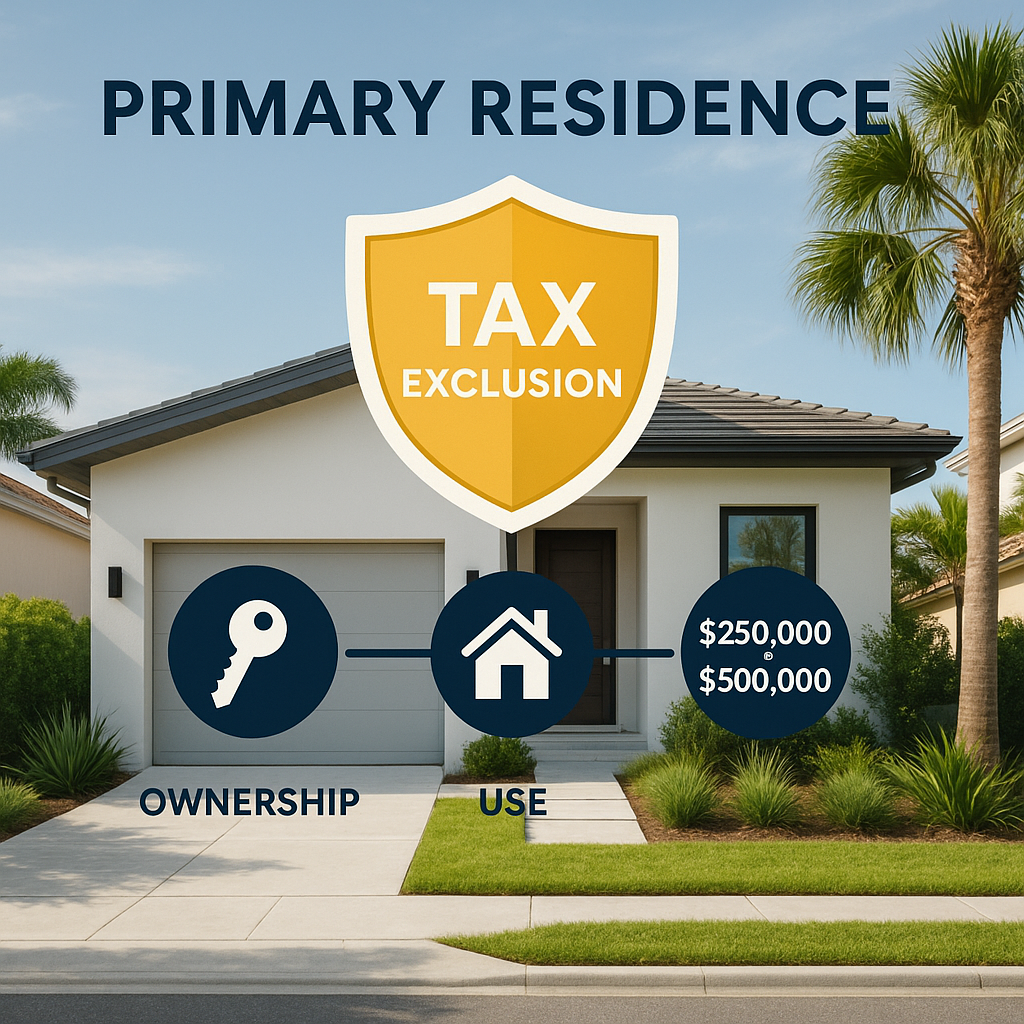
Here’s the magic trick homeowners want to know about: the Section 121 exclusion. If the home was your primary residence, you may be able to exclude up to:
– $250,000 of gain if you file as a single taxpayer
– $500,000 of gain if you file jointly as a married couple
To qualify, you generally need to pass two tests: the ownership test and the use test.
Ownership test
You must have owned the home for at least 2 years during the 5-year period ending on the date of the sale.
Use test
You must have lived in the home as your main residence for at least 2 years during that same 5-year period.
The IRS also says you usually can’t use this exclusion more than once every two years. Because apparently tax benefits need a cooldown period.
Partial exclusions may apply
If you don’t meet the full two-year requirement because of certain life events — like a job change, health issue, or unforeseen circumstance — you may still qualify for a partial exclusion.

Long-Term vs. Short-Term Capital Gains
If your gain is taxable, the next question is whether it’s short-term or long-term.
Short-term capital gains
If you owned the home for one year or less, the gain is generally taxed at your ordinary income tax rate. Translation: ouch.
Long-term capital gains
If you owned the home for more than one year, the taxable portion is generally taxed at preferential long-term capital gains rates, which are usually:
– 0%
– 15%
– 20%
According to IRS Topic 409, those rates depend on your taxable income. High-income taxpayers may also owe an additional 3.8% Net Investment Income Tax.
Pro tip: If timing the sale is flexible, a few extra months can make a real difference. One year and one day is not just a cliché — it can save real money.
How to Calculate Your Gain
A lot of homeowners assume the original purchase price is the whole story. It’s not. The real key is your adjusted basis.
Your basis may include:
– Purchase price
– Certain closing costs from the original purchase
– Capital improvements over the years
Your basis may be reduced by:
– Depreciation claimed on rental use
– Certain casualty loss deductions
– Other tax adjustments related to the property
Selling expenses can reduce your taxable gain
Common selling costs include:
– Real estate agent commissions
– Title fees
– Closing costs
– Transfer taxes
– Certain legal fees
Those costs can reduce the amount realized from the sale, which lowers the gain.
Pro tip: Keep every major improvement receipt and closing statement. Future-you will be very grateful, and present-you gets to feel annoyingly organized.

Repairs vs. Capital Improvements
This is one of the biggest “wait, what?” moments for homeowners.
Repairs usually do not increase your basis
Routine maintenance and minor fixes generally do not reduce your taxable gain. Examples include:
– Painting a room
– Fixing a leak
– Replacing a broken window
– Routine HVAC servicing
Capital improvements do increase your basis
Major upgrades that add value, extend the home’s life, or adapt it to new uses usually count as capital improvements. Examples include:
– New roof
– Kitchen remodel
– Bathroom renovation
– Adding a deck or garage
– Finishing a basement
– Replacing an entire HVAC system
This is where good recordkeeping pays off. The IRS loves documentation almost as much as your contractor loves finding “unexpected issues.”
Pro tip: If the improvement made the home better, bigger, or longer-lasting, it may help your tax basis. If it just stopped the house from falling apart, that’s usually a repair.
What Happens If the Home Was a Rental?
Ah yes, the plot twist. If the property was ever rented out, things get more complicated.
When a home is used as a rental, you may have claimed depreciation. That lowers your adjusted basis and can increase the taxable gain when you sell.
Even better — and by better, I mean worse — the depreciation portion of the gain is treated differently. The IRS may tax it as unrecaptured Section 1250 gain, with a maximum rate of 25%. And no, this part is not covered by the primary residence exclusion.
So even if most of your gain is excluded, you may still owe tax on the depreciation recapture.
State Taxes Can Change the Picture
Federal rules are only part of the story. Your state may also tax all or part of your home-sale gain.
– States with no income tax, like Florida or Texas, generally do not impose a separate state capital gains tax.
– States with income tax often tax capital gains as ordinary income.
– Some states follow the federal home-sale exclusion closely, while others do their own thing because apparently consistency is optional.
If you’re selling in a state with income tax, check the rules before closing.
Real-World Examples
Example 1: A fully excluded home sale
A homeowner buys a house for $300,000 and later spends $50,000 on major improvements. The home is sold for $550,000, and selling costs are $30,000.
– Adjusted basis: $350,000
– Amount realized: $520,000
– Gain: $170,000
If the seller meets the ownership and use tests, the entire gain may be excluded under Section 121.
Example 2: Gain above the exclusion
A married couple buys a home for $400,000 and invests $100,000 in improvements. They later sell it for $1.3 million with $70,000 in selling costs.
– Adjusted basis: $500,000
– Amount realized: $1,230,000
– Gain: $730,000
They may exclude $500,000, but the remaining $230,000 is taxable.
Example 3: A home that was rented
A homeowner lives in the house, rents it out for several years, then moves back in and sells. Even if the owner qualifies for part of the home-sale exclusion, the depreciation taken during rental years may still be taxable at up to 25%.
Key Takeaways for Homeowners
Before selling a residential property, remember these essentials:
– Many primary residence sales qualify for the $250,000/$500,000 exclusion
– You usually need to meet the 2-out-of-5-year ownership and use tests
– Holding period matters: over one year usually means long-term capital gains treatment
– Capital improvements raise basis; repairs usually do not
– Rental use can trigger depreciation recapture
– State tax rules may still apply
The bottom line: capital gains tax on residential properties is often manageable, but only if you understand the rules before you sell. A little planning can save a lot of money — which is always nicer than donating extra dollars to the tax gods.
Joe Brown is a Tampa-based residential and commercial real estate advisor with Century 21 LIST with BEGGINS, helping homeowners, investors, and business owners make informed real estate decisions throughout the Tampa Bay area.
Contact me with any questions at [email protected] or reply to this post to subscribe to my monthly commercial real estate newsletter for more insights.