
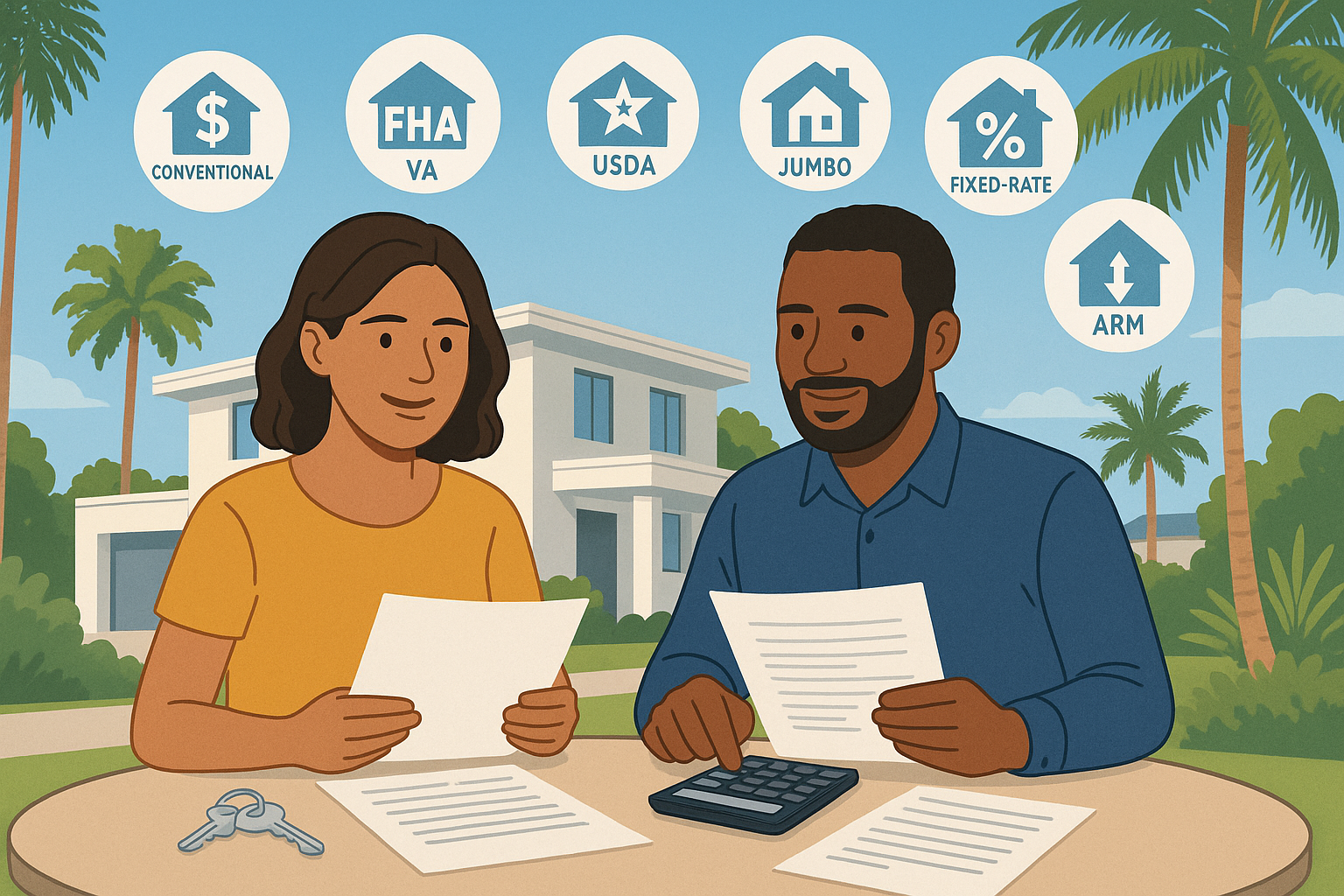
Picking a mortgage can feel a little like ordering at a diner when you’re starving and the menu was clearly designed by someone who hates decision-making. The good news? The main types of mortgage loans are easier to understand once you know what actually matters: credit, cash, and how much risk you’re comfortable carrying.
Here’s the quick answer: mortgage loans generally fall into two main buckets — conventional loans and government-backed loans — with a few special categories like jumbo loans and different rate structures layered on top. That basic framework still shapes most home financing in the U.S., including the Tampa and Florida markets where prices, rates, and affordability can make or break a deal.
Let’s break it down without the mortgage jargon doing parkour across the page.

1. Conventional Loans
Conventional loans are the standard-issue option in the mortgage world. They’re not insured by a federal agency like the FHA, VA, or USDA. Instead, private lenders usually offer them, and they often get sold to Fannie Mae or Freddie Mac after closing. Mortgage finance: glamorous stuff, right?
Who Conventional Loans usually fit
Conventional loans tend to work best for borrowers who have:
– Strong credit
– Steady income
– A manageable debt-to-income ratio
– Some cash saved for a down payment
Typical Conventional Loan features
– Down payments as low as 3% for some qualified buyers
– Credit scores often starting around 620
– Private mortgage insurance, or PMI, if you put less than 20% down
Pros of Conventional Loans
– Usually competitive interest rates
– PMI can be removed once you build enough equity
– Flexible for many property types
Cons of Conventional Loans
– Stricter qualification standards than some government-backed loans
– PMI adds to your monthly payment if you don’t put much down
Freddie Mac has long pointed out that borrowers with stronger credit often do well with conventional financing because the long-term cost can be lower than other options. Pro tip: If your credit is solid and your savings are decent, conventional financing may save you money over time — not exactly flashy, but neither is paying less interest, which is kind of the point.
2. FHA Loans
FHA loans are backed by the Federal Housing Administration and are especially popular with first-time buyers or people who need a little more flexibility. Translation: this is often the “I’m buying a house, not a castle” loan.
Why buyers choose FHA Loans
– Down payment as low as 3.5% with a credit score of 580 or higher
– More forgiving credit guidelines than many conventional loans
– Gift funds may be allowed for part of the down payment or closing costs
Pros of FHA Loans
– Easier to qualify for
– Helpful for buyers with limited savings
– Good option for people rebuilding credit
Cons of FHA Loans
– Requires mortgage insurance upfront and monthly
– Mortgage insurance may last for the life of the loan in many cases
– Property condition standards can be stricter
According to HUD, FHA loan limits were adjusted again for 2025, which matters a lot in higher-priced markets where home prices keep trying to outrun common sense. That helps buyers in expensive areas, but it doesn’t magically make those homes cheaper. Real estate likes to keep things interesting like that. Pro tip: FHA can be a smart stepping stone if you need flexibility now — just make sure the monthly mortgage insurance doesn’t sneak up and stage a coup in your budget.

3. VA Loans
VA loans are available to eligible veterans, active-duty service members, and some surviving spouses. And honestly, this is one of the best loan programs out there for qualified borrowers. No drama, no fluff, just strong benefits.
Key advantages of VA Loans
– No down payment in many cases
– No monthly mortgage insurance
– Often lower interest rates than comparable conventional loans
Things to know about VA Loans
– The VA doesn’t set a hard minimum credit score, but lenders usually do
– A one-time funding fee typically applies, though it can often be financed
– The home must be used as a primary residence
Best for VA Loans
VA loans are ideal for military-connected buyers who want to preserve cash and keep monthly payments as low as possible.
According to the VA, these loans remain one of the strongest affordability tools available because of the no-down-payment structure and the lack of mortgage insurance. That’s a pretty sweet setup in a market where every dollar seems to have a side hustle. Pro tip: If you qualify for VA financing, don’t treat it like a backup option — it’s often one of the best options, period.
4. USDA Loans
USDA loans are backed by the U.S. Department of Agriculture and are designed for eligible rural and some suburban areas. And no, “rural” does not automatically mean cows, cornfields, and a gas station that also sells bait. Some suburban areas qualify too.
Main benefits of USDA Loans
– No down payment for many qualified borrowers
– Competitive interest rates
– Can work well for moderate-income households
Requirements for USDA Loans
– Property must be in a USDA-eligible area
– Income limits apply
– The home must be a primary residence
Pros of USDA Loans
– Great for buyers with limited cash
– Often overlooked, which can make it a smart option in the right area
Cons of USDA Loans
– Location restrictions
– Income restrictions
– Fewer lenders offer them compared with conventional loans
USDA financing can be a lifesaver for buyers who want to live outside a major metro core but don’t want to scrape together a giant down payment just to get in the door. Pro tip: Always check USDA eligibility early — the map matters, and finding out too late is about as fun as discovering the roof leak after the furniture is in place.
5. Jumbo Loans
Jumbo loans are for homes that exceed conforming loan limits set by the Federal Housing Finance Agency. In plain English: if the home price is high enough that it goes beyond the limits for Fannie Mae or Freddie Mac, you’re in jumbo territory.
Typical Jumbo Loan borrower profile
– Strong credit
– Higher income
– Larger cash reserves
– Often a larger down payment
Pros of Jumbo Loans
– Lets buyers finance higher-priced homes
– Can be surprisingly competitive for very strong borrowers
Cons of Jumbo Loans
– Stricter approval requirements
– Often requires more money down
– Usually needs stronger documentation and reserves
In 2024 and 2025, higher conforming loan limits have pulled some buyers out of jumbo status and back into conventional lending, which can save real money. That matters especially in expensive markets, where a small change in loan limits can feel like finding an extra fry at the bottom of the bag. Pro tip: If you’re close to the loan limit, have your lender run both scenarios — “almost jumbo” is not a category you want to guess about.

Fixed-Rate vs. Adjustable-Rate Mortgages
This is the part that causes the most head-scratching for buyers, but it really comes down to one question: do you want certainty now, or a lower payment up front with some future mystery sprinkled in?
Fixed-Rate Mortgages
A fixed-rate mortgage keeps the same interest rate for the life of the loan.
Best for Fixed-Rate Mortgages
– Buyers who want predictable payments
– People planning to stay in the home long term
– Anyone who hates surprises in their monthly budget
Pros of Fixed-Rate Mortgages
– Stable payment
– Easy to budget
– Protects you from rising rates
Cons of Fixed-Rate Mortgages
– Usually starts with a higher rate than an ARM
If you want peace of mind and you like knowing exactly what your housing payment will be next month and five years from now, fixed-rate is usually the safer bet. Pro tip: Fixed-rate loans are boring in the best possible way — and boring is excellent when it comes to your mortgage.
Adjustable-Rate Mortgages (ARMs)
An ARM starts with a fixed interest rate for a set period, then adjusts periodically.
Common examples of ARMs
– 5/1 ARM
– 7/1 ARM
That means the rate stays fixed for 5 or 7 years, then changes once a year after that.
Best for ARMs
– Buyers who may sell or refinance before the adjustment period
– People who want a lower initial payment
Pros of ARMs
– Lower starting rate
– Can help with affordability in the early years
Cons of ARMs
– Payment can rise after the fixed period
– Harder to predict long-term costs
In a higher-rate environment, ARMs can look more attractive when the gap between ARM rates and fixed rates gets wide enough. But if you’re planning to stay put for a long time, the savings up front may not be worth the future uncertainty. Pro tip: If you’re considering an ARM, make sure you understand the adjustment caps — because “it’ll probably be fine” is not a budgeting strategy.
Which Mortgage Loan Is Best?
There’s no one-size-fits-all winner here. The best mortgage depends on your credit, income, savings, location, and how long you plan to stay in the home. In other words, the “best” loan is the one that fits your life, not the one that sounds nicest in a sales pitch.
A quick cheat sheet
– Conventional: best for strong credit and moderate savings
– FHA: best for lower down payments and more flexible credit
– VA: best for eligible military borrowers
– USDA: best for qualifying rural or suburban buyers
– Jumbo: best for higher-priced homes
– Fixed-rate: best for stability
– ARM: best for short-term ownership or lower initial payments
If you’re comparing options, don’t just stare at the interest rate like it’s a magic number. Look at the full monthly payment, mortgage insurance, fees, and how long you plan to keep the loan. Pro tip: The cheapest-looking loan is not always the cheapest loan — a little mortgage math now can save you from a very expensive “oops” later.
Final Thoughts
The right mortgage can make homeownership feel manageable instead of stressful. The wrong one can quietly drain your budget every month while smiling politely from your statement. That’s why it pays to compare loan types, not just rates.
If you’re buying in a market like Tampa Bay, the structure of your financing can matter just as much as the house itself. A smart loan choice can improve affordability, preserve cash, and give you more flexibility if your plans change later.
Joe Brown is a Tampa-based residential and commercial real estate advisor with Century 21 LIST with BEGGINS, helping homeowners, investors, and business owners make informed real estate decisions throughout the Tampa Bay area.
Contact me with any questions at [email protected] or reply to this post to subscribe to my monthly commercial real estate newsletter for more insights.
Leave a Reply