
Florida property taxes have a special talent for showing up like an uninvited relative at Thanksgiving: nobody asked, everybody notices, and somehow they always leave with more money than they came with. And if you own a home in Florida, especially in Tampa Bay or any other fast-moving market, you’ve probably felt that little jolt of “Wait… why did my bill do that?”
Save Our Homes is one of the biggest protections Florida primary residents have against wild tax increases. And now, with the proposed “Save Our Homes from Excessive Property Taxes” amendment getting attention, homeowners have even more reason to understand how this works before your tax bill starts acting like it’s auditioning for a horror movie.

What Is Save Our Homes?
Florida’s Save Our Homes (SOH) amendment was approved by voters in 1992 and took effect in 1995. It applies to homes that qualify for the Homestead Exemption, meaning the property has to be your primary residence.
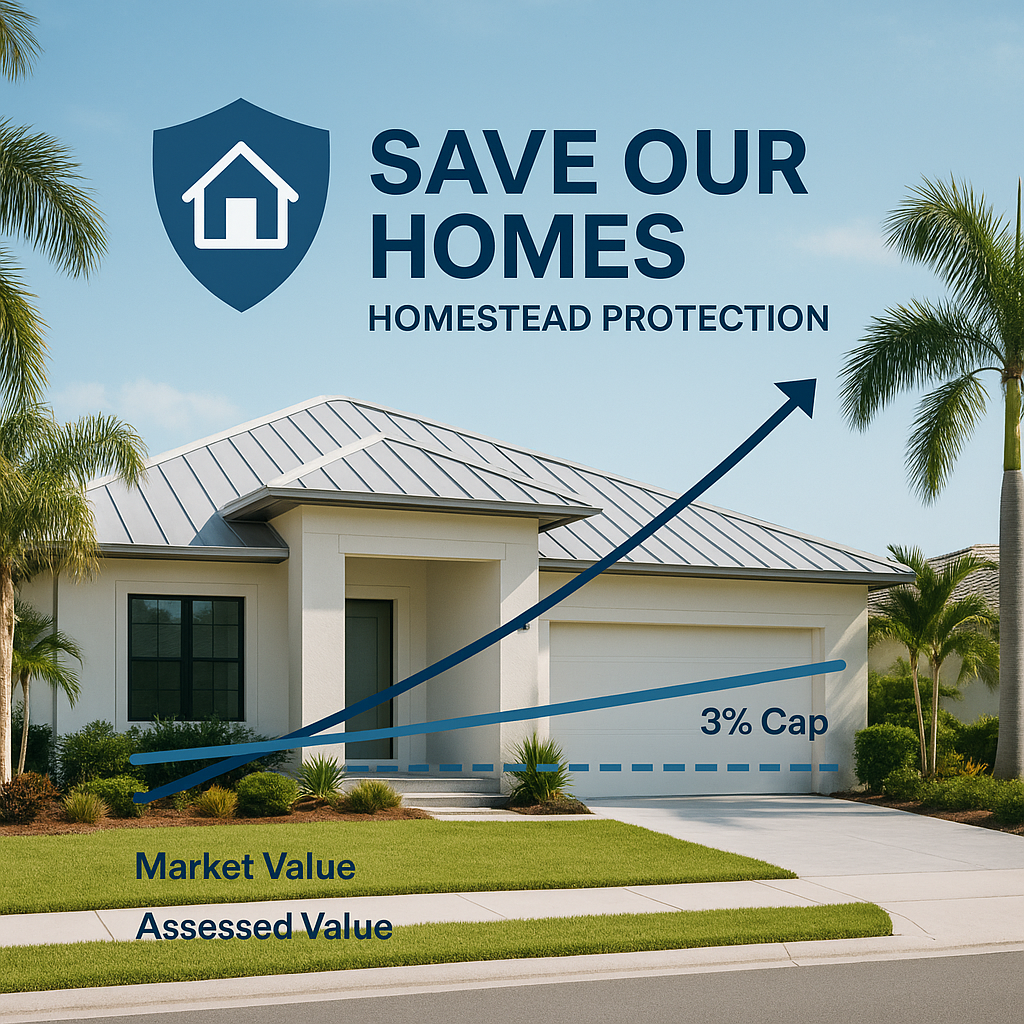
Here’s the short version: Save Our Homes limits how much the assessed value of a homesteaded property can increase each year.
The basic rule:
– Annual assessment increases are capped at 3% or the change in the Consumer Price Index (CPI), whichever is lower
– The cap starts the year after the home gets homestead status
– The cap applies to assessed value, not the final tax bill itself
That last part is the sneaky little detail people miss. Your assessed value may be protected, but if local tax rates go up, your actual bill can still rise. Florida taxation, in other words, always likes to keep one eyebrow raised.
Pro tip: Save Our Homes protects how fast your property is assessed, not what your local taxing authorities decide to do with the rate. Tiny wording change, big money difference.
Why This Matters for Homeowners
The whole point of Save Our Homes is to protect residents from getting smacked with a huge tax jump when home values rise quickly.
Let’s be real: if your home goes from $300,000 to $420,000 in a few years, that’s great for your equity and terrible for your blood pressure if your taxes are fully exposed. With SOH, the assessed value grows much more slowly, which can make long-term ownership a lot more manageable.
This matters most for:
– Retirees on fixed incomes
– Long-time homeowners in fast-growing neighborhoods
– Families who want predictable housing costs
That’s the beauty of it: fewer nasty surprises, more budgeting sanity, and a little less financial chaos in your inbox.

How the Assessment Cap Works
Here’s the simplest way to think about it, without needing a spreadsheet the size of a waffle iron:
1. The first year you receive homestead exemption, the home is assessed at its just value or market value.
2. In later years, the assessed value can only rise by the annual cap.
3. If market value grows faster than the cap, the gap becomes your Save Our Homes benefit.
Example
A home is:
– Market value: $400,000
– Assessed value: $300,000
That means the homeowner has a $100,000 SOH benefit.
That benefit can grow over time, especially in hot markets where prices climb faster than a raccoon up a fence when it hears a trash can lid.
What Happens When You Sell?
One of the biggest features of Save Our Homes is that the benefit generally does not transfer to a new owner.
When a homesteaded property is sold:
– The homestead exemption is removed
– The Save Our Homes cap ends
– The property is usually reassessed at full market value for the new owner
Translation: the buyer may get a tax bill that looks a lot less charming than the seller’s. That’s why two identical houses on the same block can have wildly different tax bills. Same shingles, different story.
This is also why long-time owners often enjoy much lower taxes than new purchasers in the same neighborhood.

Portability: A Valuable Exception
Florida does allow many homeowners to transfer, or “port,” some of their accumulated SOH benefit to a new homestead.
According to Florida property appraiser resources:
– Up to $500,000 of benefit can be transferred
– The new homestead must be established within the allowed timeframe
– The portability window is now three tax years from January 1 of the last qualified homestead exemption
This can be a lifesaver if you’re downsizing, relocating, or moving somewhere else in Florida. Because yes, sometimes the dream house comes with a dream kitchen and a dreamier tax strategy.
Why portability matters
It helps reduce the “lock-in effect,” where homeowners hesitate to move because they don’t want to lose their tax advantage.
Who Benefits Most?
Save Our Homes tends to benefit homeowners who have owned their property for a long time in places where values have climbed quickly.
That includes many owners in:
– Tampa Bay
– Miami-Dade
– Broward
– Pinellas
– Hillsborough
– Other fast-growth Florida markets
The longer someone has owned their homestead, the bigger the gap can become between assessed value and market value. And that gap can get spicy — in some cases, it may represent tens or even hundreds of thousands of dollars in protected taxable value.
In other words: loyalty to your home can come with a very real tax reward.
Common Criticisms of Save Our Homes
Now, before we crown SOH the hero of every property tax story, there are some real criticisms too.
1. Uneven tax treatment
Two homes on the same street may have very different tax bills simply because one owner has lived there longer.
2. Mobility issues
Because moving can reset taxes, some owners stay in homes that no longer fit their needs.
3. Pressure on local governments
Since homestead assessments rise more slowly, local governments may lean more heavily on:
– New construction
– Non-homestead property
– Tax rate adjustments
4. Confusion about what it does
A lot of people think SOH caps the actual tax bill. It doesn’t. It caps assessment growth, not millage rates.
That last one is the classic “wait, what?” moment. The cap is real, but it’s not magic fairy dust.

What Is the New “Save Our Homes from Excessive Property Taxes” Proposal?
Recent discussion in Florida has centered on a proposed ballot amendment called “Save Our Homes from Excessive Property Taxes.” According to the governor’s public announcement, the proposal would increase the homestead exemption and provide additional relief for homeowners dealing with rising property taxes.
And yes, this is different from the original Save Our Homes cap.
In plain English:
– Old Save Our Homes: limits how fast assessed value can rise
– New proposal: would increase the amount of value exempt from taxation
If voters approve it, this could lower the taxable base directly for many homeowners.
Because it’s being discussed as a constitutional amendment, it would have to go through Florida’s ballot process and earn strong voter support before becoming law.
Pro tip: Don’t assume a headline tells the whole story. In tax law, the devil is always hiding in the footnotes wearing a fake mustache.
What Homeowners Should Watch For
If this proposal keeps moving, homeowners should pay attention to:
– The exact exemption amount being proposed
– How it interacts with the existing $25,000 homestead exemption and other exemptions
– Whether it affects school taxes, local taxes, or both
– Whether portability or other homestead protections are also changed
These details matter. Even a small wording change can have a real effect on your final tax bill.
The Bigger Picture for Florida Real Estate
Property taxes are becoming a bigger part of the Florida real estate conversation, especially as home values stay elevated in markets like Tampa.
For buyers, Save Our Homes helps explain why your neighbor’s tax bill might look nothing like yours. For sellers, it helps explain why a long-time owner may have much lower carrying costs than a new buyer. For investors and business owners, it’s a reminder that homestead protections are powerful — but they only apply to a primary residence.
And that’s the common-sense truth: taxes don’t just affect affordability. They affect buying decisions, selling decisions, and how long people stay in their homes.
Final Thoughts
Save Our Homes remains one of Florida’s most important property tax protections. It helps long-time homeowners avoid dramatic assessment increases, supports affordability, and adds a little predictability to a market that often feels anything but predictable.
At the same time, the conversation around Save Our Homes from Excessive Property Taxes shows that property tax relief is still a major issue across the state. Whether the goal is to raise exemptions, expand protections, or reduce the burden on homeowners, this is one of those topics worth watching closely.
Because when it comes to property taxes, the only thing worse than being surprised is being surprised and broke.
Joe Brown is a Tampa-based residential and commercial real estate advisor with Century 21 LIST with BEGGINS, helping homeowners, investors, and business owners make informed real estate decisions throughout the Tampa Bay area.
Contact me with any questions at [email protected] or reply to this post to subscribe to my monthly commercial real estate newsletter for more insights.